Research interests
“A Hypoxia-reoxygenation Injury Model in Self-assembling Human Cardioids”[9]
From 2026
Scheduled to present “Sarcoidosis @Duke: A Granular View” at Medicine Grand Rounds
As of 2025 · Last known relationship
Physician-scientist at Duke University
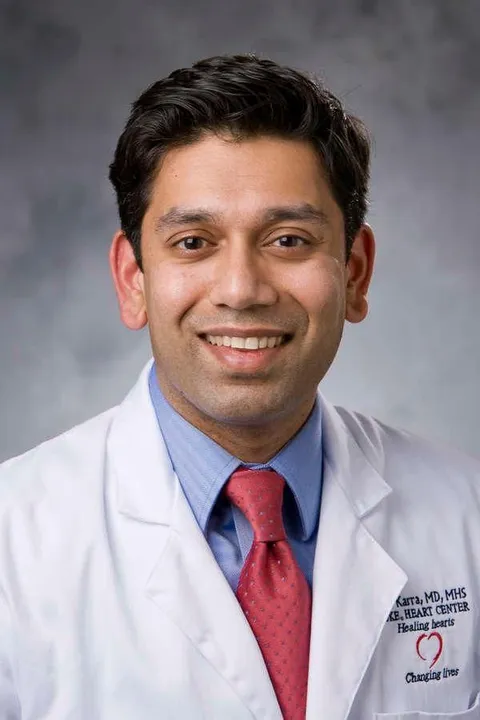
Ravi Karra is a Duke physician-scientist whose work links advanced heart-failure care with cardiac regeneration and sarcoidosis research. He is an Associate Professor of Medicine and Pathology, an Affiliate of the Duke Regeneration Center, and a Member of the Duke Cancer Institute. His laboratory studies interactions between cardiac endothelial cells and cardiomyocytes during growth and disease, while his clinical interests include heart-failure recovery and cardiac sarcoidosis. Karra earned an M.D. from Duke University School of Medicine in 2005 and completed internal-medicine residency at Brigham and Women’s Hospital from 2005 to 2008. Earlier Duke roles included Medical Instructor in Cardiology and Assistant Professor of Medicine and Pathology. He also helped form the interdisciplinary team that became Duke’s sarcoidosis Center of Excellence.
Each topic is linked to its supporting source in Sources.
Training includes Resident in internal medicine at Brigham and Women's Hospital, M.D. from Duke University School of Medicine, Scheduled to present “Sarcoidosis @Duke: A Granular View” at Medicine Grand Rounds, and Listed as the speaker for “Myovascular coupling during cardiac growth and regeneration”, plus 17 more records.
Explore education and trainingAs of 2008
As of 2005
As of 2025
As of 2022
“A Hypoxia-reoxygenation Injury Model in Self-assembling Human Cardioids”[9]
From 2026
“Automated processing pipeline for functional imaging of human cardiac organoids using optical coherence tomography”[9]
From 2026
Leading an effort in the Duke Clinical Research Unit studying neuregulin in heart failure patients[14]
“Mechanisms and Therapeutic Potential of Human Cardiomyocyte Proliferation”[9]
From 2026
“Nrg-1 is an injury-induced cardiomyocyte mitogen for the endogenous heart regeneration program in zebrafish”[14]
Research on biomarkers that may identify heart failure patients likely to recover with medical therapy[13]
Research on interactions of cardiac endothelial cells and cardiomyocytes during cardiac growth and disease[8]
Research on modulators of cardiac myocyte regeneration in zebrafish[14]
Research on the causes and treatment of cardiac sarcoidosis[11]
“Spectroscopic correlation tomography (SpCT) for visualization of spatial correlations in volumetric OCT scans”[9]
From 2026
“Tilmanocept Labels Granulomas in Cardiac Sarcoidosis”[9]
From 2026