Research interests
Publication: “Case Volumes and Outcomes Among Early-Career Interventional Cardiologists in the United States.”[7]
2024
As of 2022 · Last known relationship
Credited Sunil Rao with supporting his research and teaching him transradial interventions
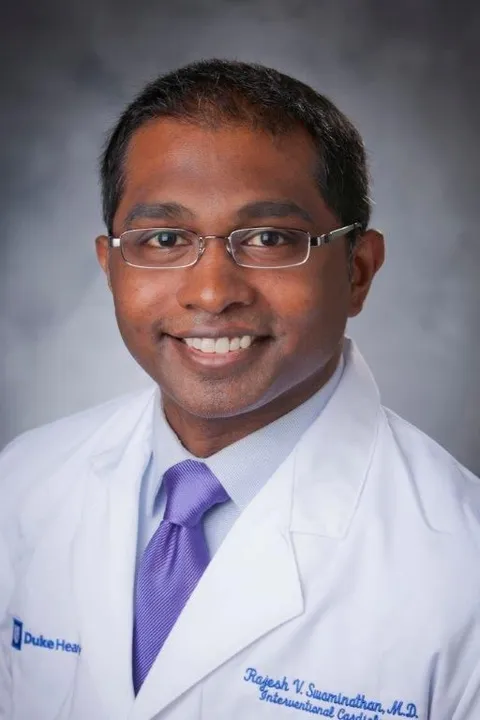
Rajesh Viswanathan Swaminathan is an Associate Professor of Medicine at Duke whose career spans cardiology, interventional training, clinical program development, research, and medical education. He earned his M.D. from Duke in 2004, completed internal medicine training at Duke and Massachusetts General Hospital, pursued research training at Harvard, and completed cardiology and interventional fellowships at Cornell. In 2022, he was appointed Section Chief of Cardiology at Durham Veterans Affairs Medical Center. His documented scholarship includes peripheral artery disease, interventional outcomes, robotic-assisted PCI, and STEMI care. His VA work also included developing cardiovascular programs, supporting multicenter research enrollment, organizing cardiology education, and delivering lectures.
Each topic is linked to its supporting source in Sources.
Training includes Speaker for a Duke Cardiology Grand Rounds session, Interventional Fellowship at Cornell University, Weill Medical College, Cardiology Fellowship at Cornell University, Weill Medical College, and Research Fellowship at Harvard University, plus 11 more records.
Explore education and training2024
As of 2021
As of 2019
As of 2012
As of 2011
As of 2008
As of 2007
As of 2005
As of 2004
As of 2022
Publication: “Case Volumes and Outcomes Among Early-Career Interventional Cardiologists in the United States.”[7]
2024
Publication: “Characterization of peripheral artery disease and associations with traditional risk factors, mobility, and biomarkers in the project baseline health study.”[7]
2024
Publication: “Robotic-Assisted Percutaneous Coronary Intervention.”[7]
2018
Publication: “Successful Peripheral Vascular Intervention in Patients with High-risk Comorbidities or Lesion Characteristics.”[7]
2021
Publication: “Temporal Trends in the Clinical Acuity of Patients with ST-Segment Elevation Myocardial Infarction.”[7]
2018